Seductive Surrogates Can Be Deadly
In clinical trials, it’s not always possible to measure hard endpoints like cardiovascular disease events and cancer remission rates. Studies that use clinical outcomes often dichotomize these variables, and as a result, they need to have a large number of participants and be long in duration to detect differences between groups.
Again, this type of research is expensive and not always feasible. In many scenarios, a more practical alternative is to focus on intermediate markers. Intermediate markers are biomarkers associated with a clinical outcome.1
For example, C-reactive protein (CRP) is a molecule that is strongly associated with inflammation, and you can often find that CRP levels increase when inflammation increases.2–4 Because inflammation is associated with coronary heart disease (CHD)5–8, an investigator may choose to focus on decreasing levels of inflammation in a clinical trial (measured by CRP), rather than focus on how many CHD-related deaths the intervention prevents.
If the changes in an intermediate marker can robustly predict changes in a hard endpoint, and if it’s part of the primary pathway of the clinical outcome, then your biomarker can be considered a surrogate marker for that clinical outcome.1 (I’m not sure if CRP is a good surrogate outcome for CHD events, just used it as an example).
Low-density lipoprotein (LDL) is considered an excellent surrogate marker for CHD because reducing LDL levels also seems to reduce the number of CHD events.9,10 Unfortunately, this can all go wrong if the intermediate marker is associated with a clinical outcome, but is not involved in the causal pathway of the outcome and is confounded by other phenomena.
Torcetrapib
A great example of this is the story of high-density lipoprotein (HDL) and myocardial infarction (heart attacks). Several studies had found associations between low levels of HDL, often considered “good cholesterol,” and heart attacks.11–17
So, it shouldn’t come as a surprise that a drug (torcetrapib) was produced by Pfizer that attempted to increase the amount of HDL with the hopes that it would reduce the number of CVD events.
A group of researchers administered the drug to thousands of patients.18 The drug was successful in changing the lipids of the participants to more favorable numbers. Patients who received the drug had a 24.9% decrease in LDL and a 72.1% increase in HDL. Seems pretty great. However, the number of deaths increased by 58% and the number of heart attacks increased by 21%.
A systematic review and meta-analysis19 published in the BMJ a few years later concluded the following after pooling studies that focused on interventions that primarily increased HDL and interventions that primarily decreased LDL,
“Available data suggest that simply increasing the amount of circulating high-density lipoprotein cholesterol does not reduce the risk of coronary heart disease events, coronary heart disease deaths, or total deaths. The results support reduction in low-density lipoprotein cholesterol as the primary goal for lipid modifying interventions.”
Svensson20 provides us with a very lovely table showing other scenarios for which a drug had a favorable effect on a surrogate marker but had a negative impact on the clinical outcome.
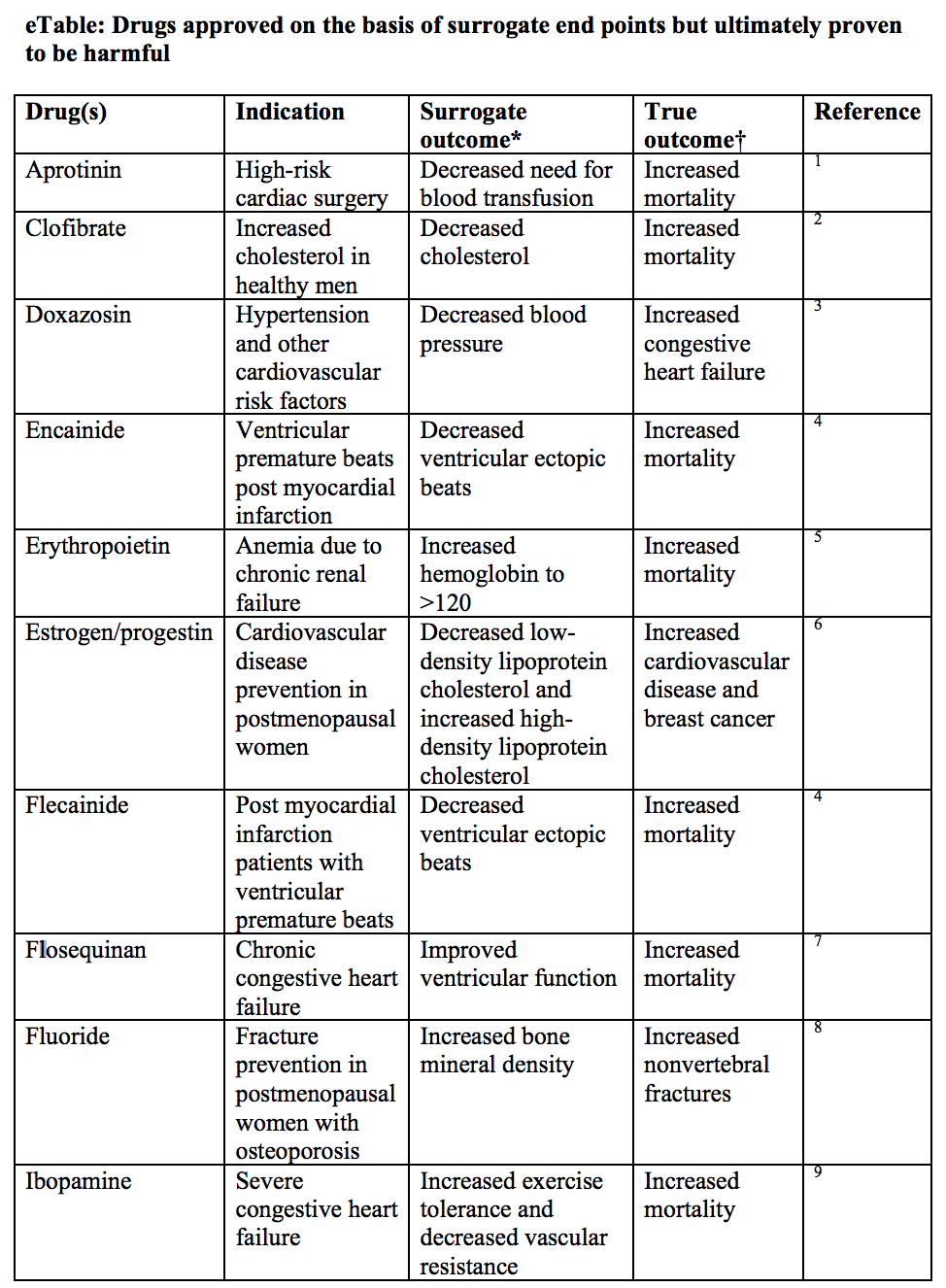
What does this tell us? That focusing only on improving surrogate markers is not a very good idea if there is not much concordance between trials that focus on surrogates and trials that focus on hard endpoints. Until we’ve established a robust causal link between a surrogate marker and a hard endpoint, we shouldn’t be seduced by surrogates.
References
Abstract
Influenza viral infection is a common and potentially fatal respiratory infection, particularly when the inflicting strain is an antigenetically novel strain that can result in severe manifestations (e.g., recent H1N1 epidemic). C-reactive protein (CRP) is a classical acute phase protein that is extremely sensitive but non-specific biomarker in many systemic inflammatory processes.[1] Discovered in 1930, CRP was so-named because it was first found to have reacted with the C-polysaccharide of cell walls of pneumococci to form precipitate.[2] Physiologically, this pentameric protein secreted from the hepatocytes is an important component of the innate immune response to inflammation and infection …
Abstract
In the mid 1990s, immunoassays for C-reactive protein (CRP), with greater sensitivity than those previously in routine use, revealed that increased CRP values, even within the range previously considered normal, strongly predict future coronary events. These findings triggered widespread interest, especially, remarkably, in the US, where the clinical use of CRP measurement had been largely ignored for about 30 years. CRP production is part of the nonspecific acute-phase response to most forms of inflammation, infection, and tissue damage and was therefore considered not to provide clinically useful information. Indeed, CRP values can never be diagnostic on their own and can only be interpreted at the bedside, in full knowledge of all other clinical and pathological results. However, they can then contribute powerfully to management, just as universal recording of the patient’s temperature, an equally nonspecific parameter, is of great clinical utility. The present torrent of studies of CRP in cardiovascular disease and associated conditions is facilitated by the ready commercial availability of automated CRP assays and of CRP itself as a research reagent …
Abstract
Myocardial necrosis triggers an inflammatory reaction that clears the wound from dead cells and matrix debris, while activating reparative pathways necessary for scar formation. A growing body of evidence suggests that accentuation, prolongation, or expansion of the postinfarction inflammatory response results in worse remodeling and dysfunction following myocardial infarction. This review manuscript discusses the cellular effectors and endogenous molecular signals implicated in suppression and containment of the inflammatory response in the infarcted heart. Clearance of apoptotic neutrophils, recruitment of inhibitory monocyte subsets and regulatory T cells, macrophage differentiation and pericyte/endothelial interactions may play an active role in restraining postinfarction inflammation. Multiple molecular signals may be involved in suppressing the inflammatory cascade. Negative regulation of toll-like receptor signaling, downmodulation of cytokine responses, and termination of chemokine signals may be mediated through the concerted action of multiple suppressive pathways that prevent extension of injury and protect from adverse remodeling …
Abstract
In this review article, Göran Hansson, a pioneer in the study of the role of inflammation in atherosclerosis and coronary artery disease, summarizes new ideas on the pathogenesis of acute coronary syndromes.
Abstract
BACKGROUND: Reducing high blood cholesterol, a risk factor for cardiovascular disease (CVD) events in people with and without a past history of CVD is an important goal of pharmacotherapy. Statins are the first-choice agents. Previous reviews of the effects of statins have highlighted their benefits in people with CVD. The case for primary prevention was uncertain when the last version of this review was published (2011) and in light of new data an update of this review is required. OBJECTIVES: To assess the effects, both harms and benefits, of statins in people with no history of CVD. SEARCH METHODS: To avoid duplication of effort, we checked reference lists of previous systematic reviews. The searches conducted in 2007 were updated in January 2012. We searched the Cochrane Central Register of Controlled Trials (CENTRAL) in The Cochrane Library (2022, Issue 4), MEDLINE OVID (1950 to December Week 4 2011) and EMBASE OVID (1980 to 2012 Week 1).There were no language restrictions …
Abstract
High density lipoprotein cholesterol (HDL-C) levels are inversely associated with the incidence of coronary heart disease (CHD) in middle-aged individuals; in the elderly, the association is less clear. Genetic factors, including variations in the cholesteryl ester transfer protein (CETP) gene, play a role in determining HDL-C levels. Controversy remains about whether CETP deficiency and the resultant rise in HDL-C are antiatherogenic, or whether CETP has the opposite effect due to its role in reverse cholesterol transport. In a seven-year follow-up of 2340 men aged 71-93 in the Honolulu Heart Program, the age-adjusted CHD incidence rates were significantly lower in men with high versus low HDL-C levels. After adjustment for age, hypertension, smoking, and total cholesterol, the relative risk of CHD for those with HDL-C levels >or=60 mg/dl, compared with those with HDL-C levels <40 mg/dl, was 0.6. Men with a CETP mutation had the lowest rates of CHD, although this was not statistically significant. These data indicate that HDL-C remains an important risk factor for CHD in the elderly. Whether a CETP mutation offers additional protection against CHD warrants further investigation.
Abstract
BACKGROUND: Inhibition of cholesteryl ester transfer protein (CETP) has been shown to have a substantial effect on plasma lipoprotein levels. We investigated whether torcetrapib, a potent CETP inhibitor, might reduce major cardiovascular events. The trial was terminated prematurely because of an increased risk of death and cardiac events in patients receiving torcetrapib. METHODS: We conducted a randomized, double-blind study involving 15,067 patients at high cardiovascular risk. The patients received either torcetrapib plus atorvastatin or atorvastatin alone. The primary outcome was the time to the first major cardiovascular event, which was defined as death from coronary heart disease, nonfatal myocardial infarction, stroke, or hospitalization for unstable angina …
Abstract
OBJECTIVE: To investigate the association between treatment induced change in high density lipoprotein cholesterol and total death, coronary heart disease death, and coronary heart disease events (coronary heart disease death and non-fatal myocardial infarction) adjusted for changes in low density lipoprotein cholesterol and drug class in randomised trials of lipid modifying interventions. DESIGN: Systematic review and meta-regression analysis of randomised controlled trials. DATA SOURCES: Medline, Embase, Central, CINAHL, and AMED to October 2006 supplemented by contact with experts in the field. STUDY SELECTION: In teams of two, reviewers independently determined eligibility of randomised trials that tested lipid modifying interventions to reduce cardiovascular risk, reported high density lipoprotein cholesterol and mortality or myocardial infarctions separately for treatment groups, and treated and followed participants for at least six months. DATA EXTRACTION AND SYNTHESIS: Using standardised, pre-piloted forms, reviewers independently extracted relevant information from each article …
Comments